- Dashboards
- Web3
- Fintech
A Web3 Dashboard for Smarter Yield
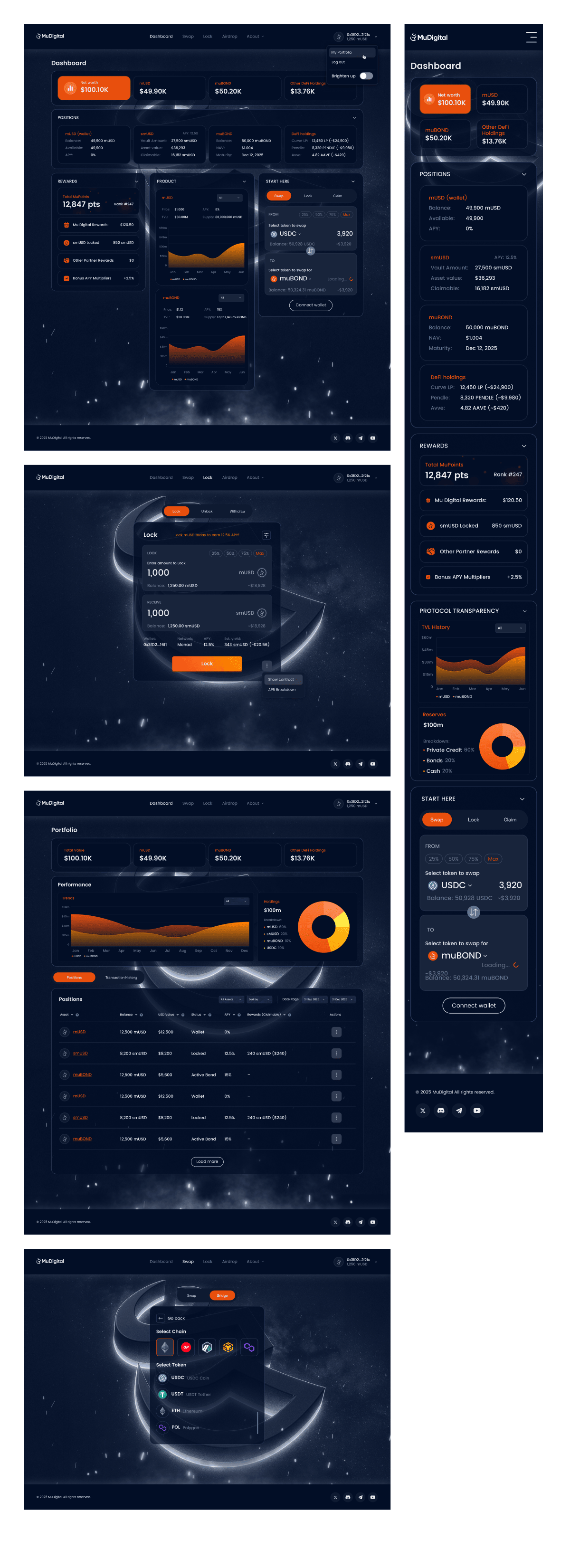
MuDigital brings Asian credit and yield products onchain. Raymond designed the whole product, from portfolio and swaps to locking, rewards and the design system, on desktop and mobile, in light and dark.
- Client
- MuDigital
- Year
- 2025
- Led by
- Ray
- Status
- Shipped
The problem
Onchain finance is hard to read. MuDigital’s users hold several kinds of asset at once: mUSD in their wallet, locked mUSD, smUSD earning yield and muBOND, a credit product with its own maturity. Add rewards, points, pending withdrawals and two networks, Ethereum and Monad, and a typical DeFi dashboard turns into a wall of numbers.
The job was to make it feel like a portfolio people recognise, where every holding is clear and the next sensible action is obvious.
What we did
Raymond was hired to design the entire product: every screen and state, on desktop and mobile, in light and dark mode. The marketing website was done by someone else.
- Dashboard and portfolio. Net worth up top, then each position with its own balance, yield, status and action. Withdrawal requests only appear when there are some.
- Earn. Lock, Unlock and Withdraw as three clear steps, so people can see when a cooldown is running and when funds are ready.
- Swap and Send. Simple forms with inline validation right where the problem is, under the amount or above the button, not a generic error.
- Two networks. A global chain selector, combined totals with a per-chain breakdown, and clear messages when an action, like staking, only works on Ethereum.
- Mu Points and airdrop. Points, season rank, quests, referrals and a leaderboard, kept visibly separate from tokens you can actually claim.
- Protocol transparency. TVL history and reserves, so users can see what backs the product.
- Investor platform. KYC onboarding and mint and redeem requests for the permissioned side.
- Design system. A Figma component library and type system with light and dark themes, built to match the engineers’ shadcn/ui, Tailwind and Radix stack.
Every state, not just the happy path
Financial products earn trust in the edge cases. Each flow was designed for a disconnected wallet, a connected wallet with nothing in it, the wrong network, loading, confirming, success and failure, with prototypes and feedback animations so the team could build exactly what they saw.
Why it matters
Whether it’s yield products or an invoicing tool, dense financial information only works when people can scan it, trust it and know what to do next. That’s what good product design is for.